
Learning Exchange has a DVD available for teachers that focuses on tips on how teachers can protect their voice.
Voice Care for Teachers includes useful strategies about managing noise, information about classroom acoustics. The DVD also looks at the many factors that can impact on the voice and teachers share stories of their own voice problems. Produced in 2007, it has been written and produced by speech pathologists Dr. Alison Russell (Adelaide), Dr. Jenni Oates (Melbourne) and Cecilia Pemberton (Sydney) who all have expertise in the prevention and management of voice problems.
The DVD is available for borrowing from Learning Exchange. Also the DVD is available for individual purchase from the Voice Care for Teachers website.
Web-based article
It's no joke if you croak
Published in The Times Educational Supplement on 7 May, 2010
By: Phyllida Furse.
Teachers use their voice more than actors do. Voice coach Phyllida Furse offers tips to newly qualified teachers on protecting this natural asset.
Ebscohost database article
The following article is an Ebscohost database article available via Staffnet. contact Learning Exchange on 9677 4344 for access to this article.
Voice Health Problems: Symptoms and Suggestions
By: DeGroot, Joanna. Teaching Music, Nov2008, Vol. 16 Issue 3, p54-55, 2p,
This article offers information on voice health problems, its symptoms and suggestions. According to Mary Lynn Doherty, assistant professor of music education at Northern Illinois University, the importance of vocal health is usually misunderstood by students and teachers though it has been a major point of concern. Doherty states that vocal health is vital for music teachers and they are more prone to these problems than general people. She also provides several tips related to voice problems.
Wednesday, November 10, 2010

Tuesday, October 19, 2010
Using iPads/iPods in classrooms with special needs students
MangoMon is a commerical organisation providing online tools for special needs students. They also have some good ideas on teaching and learning uses of online tools and technologies. For uses of iPods and iPads in classroom see this article. An interesting video on this page shows hearing impaired students learning via the use of an iPad. Scroll halfway down to see video.
Spectronics, another special education supplier also provides some good links to the use of iPads in education in their article "Educational Apps and resources for the iPad and iPhone".
CEO Parramatta also provides links to the use of Ipads in Special Education via the Learning and Teaching with Ipads blogspot. See the Special Needs Uses tab.
Friday, October 15, 2010
Team teaching - collaborative teaching
 Learning Exchange has recently added an Ebook to our collection of resources on collaborative teaching.
Ebooks are available via our Staffnet - Resources - Ebooklibrary or for more information email lex@parra.catholic.edu.au
"TeamWork : Setting the Standard for Collaborative Teaching, Grades 5-9" is full of captivating stories and insightful conversations. "The teamers" provide an honest and richly detailed explanation of collaborative teaching in action. They deliver the straight scoop on teaming, offering insights on these and other key topics:how to shape a shared purpose for learning by mining the talents of students and colleagues;how to build strong partnerships with parents, principals, and other key people who influence the lives of young adolescents; how to deepen curriculum integration by "cutting the fluff.
Along with this the publishers Stenhouse have provided a downloadable study guide that complements the book. The study guide is available from their website. In addition this webpage provides access to podcasts on "what it takes to make a team successful" as well as articles like "Team teaching with careful planning it is not a luxury".
A list of the other resources we hold on this topic can be found at this previous post.
Thursday, August 19, 2010
Transmedia books
What is transmedia?
Wikipedia defines it thus: as storytelling across multiple forms of media with each element making distinctive contributions to a fan's understanding of the story world. By using different media formats, transmedia creates "entrypoints" through which consumers can become immersed in a story world.
What is transmedia and is it different than crossplatform?
Jill Golick explains in her blog post on Transmedia her understanding of transmedia as being a subset of crossplatform. She believes all transmedia is crossplatform, but not all crossplatform is transmedia.
"When I use transmedia two conditions have to be met:
The story world must be expressed on at least three platforms. It can be more, many more, but three is the minimum.
The expression of the story world on each platform must be unique, not the same content repurposed on a different platform. So Harry Potter, in which the movies, video games and other elements are all retellings of the books that JK Rowling wrote? Not transmedia. Julia Child’s autobiography, My Life in France, Julie Powell’s blog The Julie/Julia Project and Nora Efron’s movie, Julie and Julia? Transmedia. (I have a post elaborating on this thought on the blog TransmediaTracker.)

Transmedia books to explore
Wikipedia defines it thus: as storytelling across multiple forms of media with each element making distinctive contributions to a fan's understanding of the story world. By using different media formats, transmedia creates "entrypoints" through which consumers can become immersed in a story world.
According to Henry Jenkins, author of the book Convergence Culture, transmedia storytelling is a process where integral elements of a fiction get dispersed systematically across multiple delivery channels for the purpose of creating a unified and coordinated entertainment experience. Ideally, each medium makes it own unique contribution to the unfolding of the story.”
What is transmedia and is it different than crossplatform?
Jill Golick explains in her blog post on Transmedia her understanding of transmedia as being a subset of crossplatform. She believes all transmedia is crossplatform, but not all crossplatform is transmedia.
"When I use transmedia two conditions have to be met:
The story world must be expressed on at least three platforms. It can be more, many more, but three is the minimum.
The expression of the story world on each platform must be unique, not the same content repurposed on a different platform. So Harry Potter, in which the movies, video games and other elements are all retellings of the books that JK Rowling wrote? Not transmedia. Julia Child’s autobiography, My Life in France, Julie Powell’s blog The Julie/Julia Project and Nora Efron’s movie, Julie and Julia? Transmedia. (I have a post elaborating on this thought on the blog TransmediaTracker.)
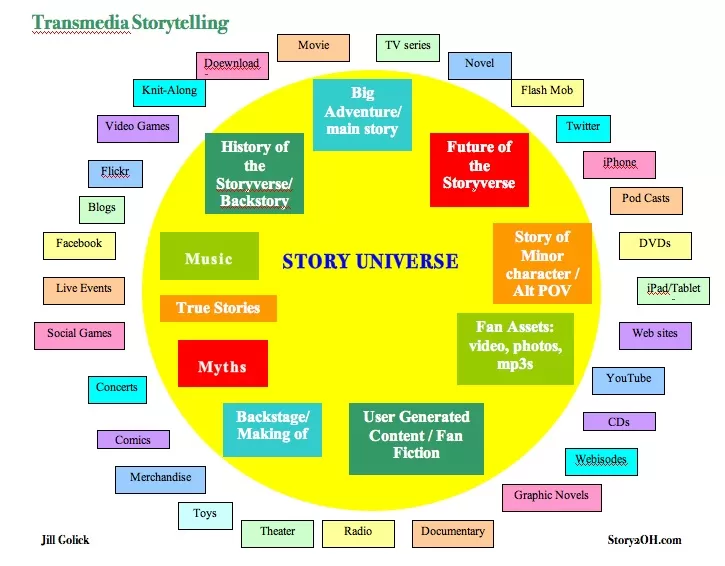
Transmedia books to explore
“Skeleton’s Creek – Ryan’s Journal” is the first book in a new series by author Patrick Carman. Carman has already experimented with New Media in his Atherton series and, once again, he returns to the format with this new book and series which is, ostensibly, a kind of ghost story – with a secret society thrown into the overall mystery. Taking into account that this book is aimed at adolescents, the results are almost entirely positive with Carman weaving a successfully creepy and suspenseful tale, while taking advantage of the internet to augment his story.
ref: http://dauntlessmedia.net/patrick-carman/skeleton-creek/skeleton-creek-1-ryans-journal.html
2. 39 clues
YA book series like The 39 Clues, which ask participants to read the book and investigate clues online.
39 Clues tells the story of two children, Amy and Dan Cahill, who are thrust into a global hunt for clues that will reveal the secret to the Cahill family’s power. The series is a cross between The Westing Game and The Amazing Race as the two children compete against members of four branches of the Cahill family to uncover the secret histories of famous Cahills including Benjamin Franklin, Anastasia Romanov, and Amelia Earhart. Although the series initially portrays their competition as cutthroat caricatures of their respective family houses, the series gradually reveals the complex motives of their fellow competitors.
While the story is primarily told through the books, each novel serves as a launching pad for further exploration, as a number of clues are hidden within each book’s pages. For instance, in The Maze of Bones, a series of apparently misnumbered pages spells out a secret message that aids the reader in solving a puzzle on one of the six collectible cards that came with the book. By going to the 39 Clues website, the reader can complete a puzzle solving mission culminating in an online game that explains the message.
Scholastic assembled materials to help teachers using 39 Clues in the classroom, and libraries have organized 39 Clues discussion sessions “to attract a new crew of young patrons through their doors to meet, share, and sleuth to solve the fantasy adventure as a team.”
Level 26.com and the Level 26 books combine to form a "digi-novel," a multi-platform experience that moves the reader from passages in the books to videos and interactive content right here on the Level 26 website.
Level 26.com and the Level 26 books combine to form a "digi-novel," a multi-platform experience that moves the reader from passages in the books to videos and interactive content right here on the Level 26 website.
How do I participate in the digi-novel?
Read the books, sign up for a profile, and enter codes to unlock the Cyber-bridges.
The first installment in the series "Level 26: Dark Origins," will be available in stores and online September 8th. As you read the book, you'll see calls-to-action that direct you to this website to sign up for a profile and enter codes to unlock Cyber-bridges. These cinematic Cyber-bridges take the experience to the next level, immersing you in the action and putting you inside the twisted mind of a serial killer.
4. Nubs
The book Nubs is a true story about a dog and a Marine in Iraq. The website includes facts about the story, a book trailer, photo gallery, and a review of the locations in the story. Use this book to start an exploration of animal and journey stories. Think about ways you could create your own multi-platform story.
5. Cathy's story
Written for a young adult audience, Cathy's Book, Cathy's Key and Cathy's Ring by Sean Stewart and Jordan Weisman includes an evidence packet along with a website for each book. A website is also available for fans who want to discuss the book. The fictional character has Facebook and Flickr accounts you can visit.
Ref: http://eduscapes.com/earth/informational/transmedia.html
Other transmedia to explore
Metro2033 is a computer game. The premise is a post-apocalyptic Moscow where humanity has retreated to the subway Metro system. On the surface are mutants and desolation. Below is factional subterranean tribal states in the Metro tunnels.
Metro 2033 been getting rave reviews as a game but what’s interesting in the context of Transmedia is a) that its based on a novel and b) that the original novel was self-published online.
Normally, viewers experience the story of the murder as they travel a mapped route around Boston’s Beacon Hill, watching sections from the video at eight different stops. At the film festival, though, audiences will stay firmly in their seats, watching all 33 parts of the video in continuous order. “We were just blown away at how watchable the story is in a theatrical setting,” BIFF director Patrick Jerome said in a statement. “It’s quick-paced, full of juicy details, and, to our knowledge, it’s the first location-based application to screen at a film festival.” Untravel Media, founder Epstein says the film’s acceptance at BIFF is a sign that the filmmaking community is gradually waking up to the possibilities of transmedia storytelling—in particular, storytelling that immerses viewers in a thoughtful way in real geography. “For a few years now we’ve been talking about doing more than your typical audio guides and walking tours,” Epstein says. “With the iPhone, apps can be fairly rich, so filmmakers know their stories won’t be reduced to little clips, but that the actual story can be expanded and become more engaging.”
Tuesday, August 10, 2010
RDA the new era in cataloguing

A new era in cataloguing is about to take place with the introduction of RDA. RDA: Resource Description and Access is the new descriptive cataloguing standard that will replace the Anglo American Cataloguing Rules2 (AACR2).
In CEO Parramatta the library system support staff will be working closely with our library software supplier SirsiDynix to integrate changes as need be as well as keeping our school libraries informed. The aim of this post is just to provide a bit of background information about RDA for all library staff.
The aim of RDA is that cataloguing rules be easy to use and interpret and be applicable to an online, networked environment. Additionally it aims to provide effective bibliographic control for all types of media, and encourage use beyond the library community.
An example of one change is to provide users with better data about content and carrier of the content. General material designations (GMDs) and specific material designations (SMDs) used in AACR2 will be replaced in RDA with new elements to describe content and carrier. The current GMDs are a mixture of terms designating both content and carrier. For example, the GMD “videorecording” can be used for both videocassettes and DVDs. OPAC displays based on the current AACRC2 rules do not always give the user a clear indication of the content of the resource and the type of carrier the content is contained in. Let us take the example of a user wanting to view a particular feature film, say “The Titanic,” on a specific type of player. What he or she really wants to know is that the content of the resource is a moving image, and that the carrier is either a videocassette or a DVD. The OPAC display should be able to make these characteristics explicit. (Ref: The Potential Impact of RDA on OPAC Displays by Philip Hider and Ann Huthwaite)
If you want to know more about RDA the National Library of Australia has a page of articles, links and presentations about RDA at their RDA webpage.
A slideshare presentation Tools of our trade by Ann Chapman of London Metropolitan University also neatly summarises the differences.
Tools of our Trade (RDA, MARC21) 2010-03-15
View more presentations from Ann Chapman.
School vision
Articles
Available via Ebschost databases. If having access problems please contact lex@parra.catholic.edu.au
Partnerships for... inspiration.
Rossiter, Sue
Education Journal; Dec2008, Issue 113, p37-37, 1p
The article focuses on the importance and role of students in the process of building new schools and their strong association in new surroundings and school experience and expectations. It states that students are involved for the development of school vision and redevelopment of the construction of school. It also notes that the Centre for Excellence and Outcomes in Children and Young People's Services aims to transform outcomes for young people and their families.
What is vision & How do you get one?
Scoolis, James
Thrust for Educational Leadership; Nov/Dec98, Vol. 28 Issue 2, p20, 3p
Discusses the importance of vision in an educational organization. Definitions of vision; Ways to develop effective school visions; Details on the document entitled `The Walk,' an activity that asks participants to provide specific information that will be used in vision creation.
Why change doesn't happen and how to make sure it does.
Schwahn, Charles Spady, William
Educational Leadership; Apr98, Vol. 55 Issue 7, p45, 3p, 1 Color Photograph
Looks at strategic alignment for achieving the schools vision and productive changes for children. How successful strategic alignment occurs; Five rule for productive change; How educational leaders in Yarmouth significantly more than 2,000 people in the strategic planning process.
http://search.ebscohost.com/login.aspx?direct=true&db=tfh&AN=590581&site=ehost-live&scope=site
Books
• Literacy leadership : six strategies for peoplework McAndrew, Donald A. 2005
• The new principal's fieldbook : strategies for success Robbins, Pam 2004
• Heroic leadership : best practices from a 450-year-old company that changed the world Lowney, Chris. 2003
• Centering educational administration : cultivating meaning, community, responsibility Starratt, Robert J. 2003
• Primal leadership : realizing the power of emotional intelligence Goleman, Daniel. 2002
• Joel Barker's Leadershift [kit] : five lessons for leaders in the 21st century Barker, Joel Arthur. 1999
• The strategic human resource leader : how to prepare your organization for the six key trends shaping the future Rothwell, William J., 1951- 1998
• The Tao of personal leadership Dreher, Diane, 1946- 1996
• Focus your vision [kit] Jones, Dewitt 2005
• Transforming schools through powerful planning Psencik, Kay 2004
Ebooks
Available for browsing from EBook library. Purchase of any books available upon request from Ebook library. Contact LEX for more details.
• Generating Buy-In : Mastering the Language of Leadership Walton, Mark S.AMACOM 2003 9780814427668
• Rethinking Educational Leadership : Challenging the Conventions Bennett, N; Anderson, L SAGE Ltd. 2003 9781847876164
• Values for Educational Leadership Haydon, Graham SAGE Ltd .2007 9781848605015
• Passionate Leadership in Education Davies, Brent; Brighouse, Tim SAGE Ltd. 2008 9780857026958
School change
Articles
Available via Ebschost databases. If having access problems please contact lex@parra.catholic.edu.au
4 core strategies for implementing change.
Loesch, Paul C.
Leadership; May/Jun2010, Vol. 39 Issue 5, p28-31, 4p
The article focuses on core strategies suggested to be taken by schools in narrowing the achievement gap among students. It stresses that school districts should adopt to change in order to implement better means of improving student performance. It also states that identification of the problem and devising a plan are factors which contribute to a successful problem-solving in the field of education. Moreover, it emphasizes that schools should abide with definite goals.
Implementing school-wide behavior change: Lessons from the field.
George, Michael P. White, George P.
Schlaffer, Joseph J.
Psychology in the Schools; Jan2007, Vol. 44 Issue 1, p41-51, 11p, 1
In this article, we examine two schools that successfully adopted school-wide positive behavior interventions and highlight some of the common features that contributed to their success. As part of our analysis, we draw upon the theoretical literature on organizational change to discuss factors that supported these successful school-wide
reform efforts, including the contributions of administrators, teachers,
and school psychologists.
Books
• The challenge of change : start school improvement now! Fullan, Michael. 2009
• Leading change in your school : how to conquer myths, build commitment, and get results Reeves, Douglas B., 1953- 2009
• What's worth fighting for in the principalship? Fullan, Michael. 2008
• Lead more, manage less : a five essential behaviour management insights for school leaders Richmond, Christine. 2007
• Activating the desire to learn Sullo, Robert A. 2007
• Leading schools in a data-rich world : harnessing data for school improvement Earl, Lorna M. (Lorna Maxine), 1948- 2006
• The principalship : a reflective practice perspective Sergiovanni, Thomas J. 2006
• Leading for results : transforming teaching, learning, and relationships in schools Sparks, Dennis. 2005
• Writing better : effective strategies for teaching students with learning difficulties Graham, Steven, 1950- 2005
• Teaching in the knowledge society : education in the age of insecurity Hargreaves, Andy. 2003
• Change forces with a vengeance Fullan, Michael. 2003
Ebooks
Available for browsing from EBook library. Purchase of any books available upon request from Ebook library. Contact LEX for more details.
• Building Leadership Capacity for School Improvement Harris, Alma; Lambert, Linda Open University Press 2007 9780335225699
• International Handbook of School Effectiveness and Improvement : Review, Reflection and Reframing Townsend, Tony Springer 2007 9781402057472
• Reframing Teacher Leadership to Improve Your School Reeves, Douglas B. ASCD 2008 9781416607670
• Leading Change in Your School : How to Conquer Myths, Build Commitment, and Get Results Reeves, Douglas B. ASCD 2009 9781416608929
Subscribe to:
Posts (Atom)
